

In the beginning was the command line.
- Neal Stephenson
Well, not really. Before the command line was the punch card, and before that were the various knobs and dials and patch cords of early computers. Today we use graphical user interfaces (GUIs) - things you point to and click on. Even as the means of interacting with a computer have grown easier, the ability to program them has become all the more specialized1.
Nevertheless, for most living computer programmers, in the beginning there was indeed the command line. For better or for worse, skill at the command line remains, even today, the litmus test of a good programmer. I doubt if that is universally true. I’ve seen enough good programmers who manage fine without it. But I’d wager it’s statistically true. Being dexterous at typing commands instead of navigating menus and dialogs is a huge time saver. It’s similar to the difference between touch-typing and hunt-and-peck typing.
I myself hate taking my hands off the keyboard while coding - so I’m certainly heavily biased towards the command line. But I don’t judge those who are not. There are better programmers who are not particularly invested in the command line experience, but they’d still know their way around it. Secondly, while getting good at the command line takes years, getting started is not all that hard; you only need to know a handful of commands to get most of your work done. What really exasperates me, however, are those who doggedly avoid the command line in favour of GUIs, and still end up fumbling around, wasting time and ultimately making mistakes.
I recently encountered an intern doing something similarly exasperating. He’d been asked to debug a program. After repeated attempts, the various bugfixes didn’t work. Standing behind him2, I noticed many places where he could have been significantly more efficient. Here, a distinction needs to be made between the reasoning skills needed to debug a program, and the dexterity needed to deploy the solution. My disappointment was directed solely at the latter. He kept clicking on the wrong thing in the wrong menu. Imagine teaching your tweenager nephew how to play Call of Duty. After he had killed his own teammates six times in a row, it took all my restraint and a glowering spouse not to snatch the controller away.
At first, this intern was gently nudged towards using the command line. Then he was encouraged, and finally sternly warned. He was made a full-time employee soon after, but didn’t survive the probationary period. His peers were more productive by far, and decided that they’d rather invest in someone who was interested in learning an obviously high-RoI skill.
But as I write this, I realize that I myself was perhaps not so different when I was an intern, fourteen years ago. Just as one feels embarrassed looking at their old photographs, I’m embarrassed at my old coding habits. Particularly embarrassing is my Stack Overflow profile. I’ve asked a grand total of five questions; two of which have been deleted. One of the remaining three is outright embarrassing - the kind of question that today I would fire myself for asking. The other two, while not as silly, are still the desperate attempts of someone who doesn’t know how to use Google well enough3. And then there are my answers. Far less embarrassing, but still answers to precisely those questions that a person like the past me would have asked. In fact, I was exactly someone who deserved to have their job taken away by AI. Even today, there are enough such people in workplaces that it feels like AI is just around the corner, ready to blindside the naive knowledge worker.
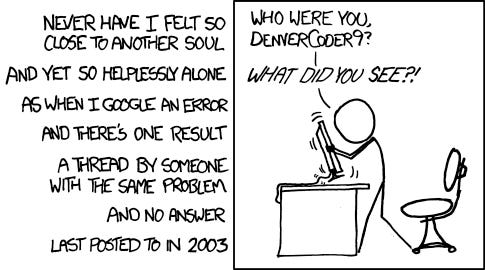
Many developers have very interesting Stack Overflow stories. A friend once told me how during his internship he was tasked with a particularly difficult problem, and no matter how far and wide he looked on Stack Overflow, the only relevant questions he saw were from other interns before him who’d failed to solve the same problem. And the only answers he saw were from his boss: the very person who gave him the assignment in the first place.
It’s an institution that’s hallowed and controversial at the same time. For no small number of programmers, their reputation on Stack Overflow has translated into real professional reputation. For a period, reputation-farming on Stack Overflow was a perfectly valid strategy for career progress. On the other hand, people also have stories about how the platform spurned them, to the point of being positively toxic. I’m not proud to admit this, but it’s not entirely impossible that I myself might have played some part in shaming an unsuspecting novice. But, all in all, Stack Overflow has been, for the better part of the last 20 years, quite central to software engineering.
And then, earlier this year, I saw posts like these go viral on social media.


As transformative4 as LLMs have been, claims that ChatGPT has ‘killed’ or ‘destroyed’ Stack Overflow seem quite overblown—not least because they are viral and loud in the first place, but also because a reduced volume of transactions by itself is hardly a good measure of the health of that platform. Luckily, this is something for which data is readily available.
As a source of information, Stack Overflow is rich in more than one way: not only as a place where answers to popular programming questions are concentrated, but also as an organization that conducts annual user surveys, and regularly archives its own data in a publicly accessible, structured format. The survey data has long been seen as the pulse of the profession. But it also has a strong self-selection bias—in that respondents are already more likely to be active on Stack Overflow. On the other hand, the data dumps are a treasure. Every question, every answer, every edit and everything there is to know about every user lies buried somewhere in the half-a-terabyte archive.
And like every social network, what is fascinating about Stack Overflow is the sheer nonlinearity of it. For example, even with my sparse set of questions and answers, I have a reputation of 3,144. This means that I’m at the 99.68th percentile. Only a third of a percent of all Stack Overflow users have a higher reputation. But here’s the kicker: there are nearly a hundred thousand of them! The highest reputation ever is at a million and a half: three orders of magnitude higher than where I am. Even if I were so inclined, scaling that peak would take me multiple lifetimes.
But no matter how large the data grows, the information contained in it is concentrated in a tiny manifold—much like the nucleus of an atom. Once we are no longer overwhelmed by the sheer magnitude of things, the pattern here is surprisingly common: the power-law distribution. In every socioeconomic system, influence and reputation are almost always highly concentrated in a vanishingly small fraction of the population. In wealth and income distribution, this is what we mean when we say that the rich keep getting richer. So when people say that ChatGPT and other LLMs destroyed Stack Overflow, it’s worth asking whether it was the nucleus that was destroyed, or the cloud of possibilities around it.
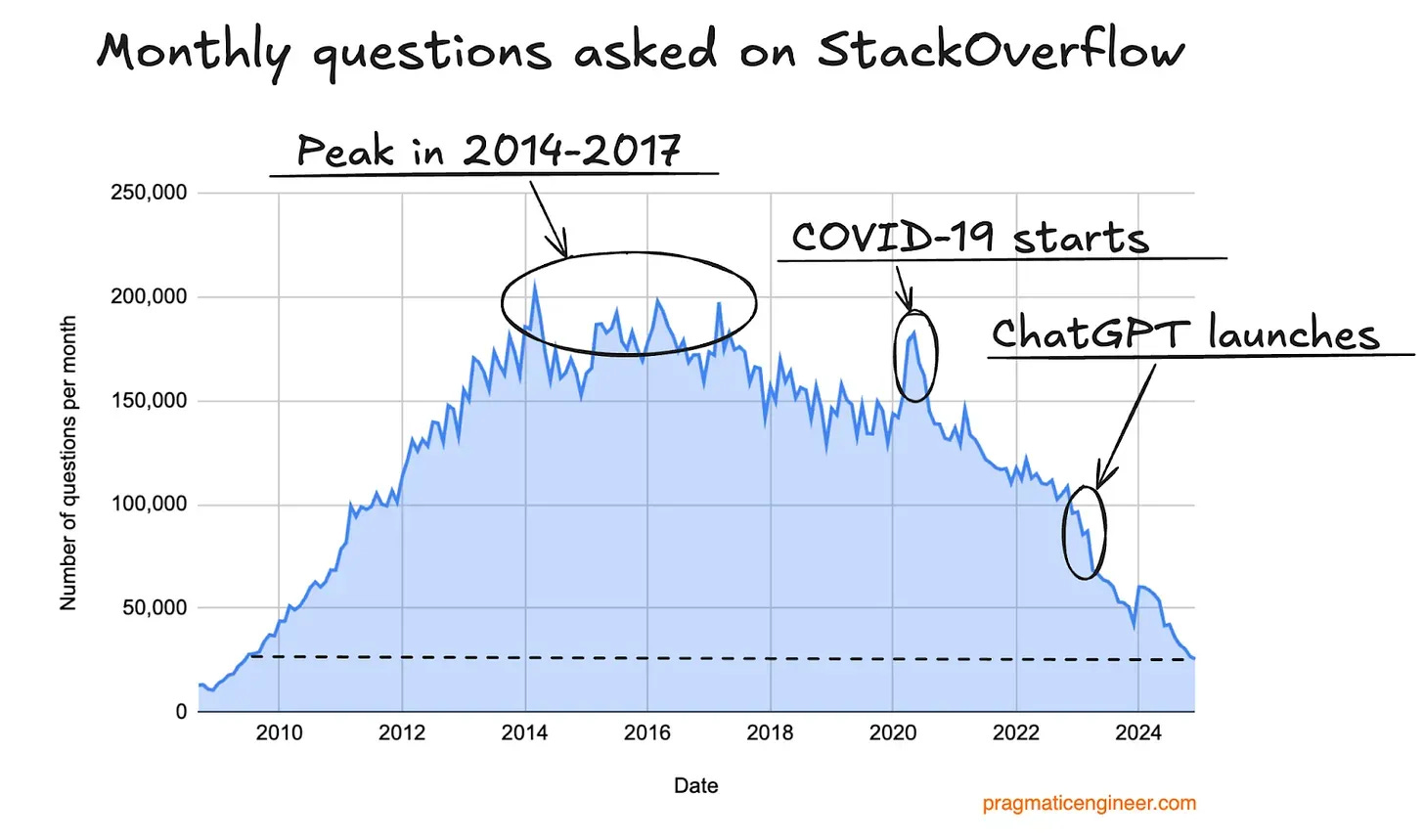
At the outset, let’s acknowledge that monthly activity on Stack Overflow did decline after the release of ChatGPT. There is indeed a steep drop in the number of questions asked since the end of 2022. The question, however, is whether that particular point in time had anything to do with the drop. Imagine, for instance, that the release of ChatGPT was not annotated on the graph above. Then we could still see the drop, but we would be tempted to trace it back to the COVID-19 pandemic (which is also annotated on the graph). Would we then say that the pandemic, like so many other people and organizations, killed Stack Overflow too? If anything, that would be a more plausible explanation, especially since activity peaked drastically during the pandemic—the taller it stood, the harder it fell. The point is that annotating graphs with events makes for really good storytelling, but it also leads the witness. So the simple antidote to this is to stop comparing data from before and after a fixed timestamp, and look at the trajectory as a whole. When seen this way, even the pandemic appears as an inflection point.
Moreover, ChatGPT wasn’t the only disruption that happened after the pandemic. First, Stack Overflow was acquired by Prosus in June 2021. Around the same time, GitHub released their AI coding assistant, Copilot, which would certainly have made asking some questions on Stack Overflow pointless. Later in mid-2023, there were a series of layoffs, an AI moderation policy, and moderators went on strike. In 2024, Stack Overflow announced strategic partnerships with Google and OpenAI—which meant, at the very least, that partners did not have to scrape training data off Stack Overflow anymore; they could acquire it officially. Ultimately, each of these events can be seen as a candidate explanation (albeit of varying strengths), and the “before and after” narrative ends up being entirely qualitative, no matter which disruption event we’re looking at—including ChatGPT. The more interesting possibility is that we’re looking at a much longer trend that predates all these disruptions, and that there are factors that aren’t visible through monthly activity.
Substitute for Another Guy
Six months ago, in an interview with Nilay Patel of The Verge, Stack Overflow CEO Prashanth Chandrasekar said that the decline was primarily in simpler questions—more complex and advanced questions continue to be asked just as much, since LLMs are only as good as the available knowledge. This gives us a good heuristic—not all questions are equal. We then distinguish “good” questions, as questions that were never marked as duplicates (something that plagues Stack Overflow significantly) and remained highly upvoted later5.
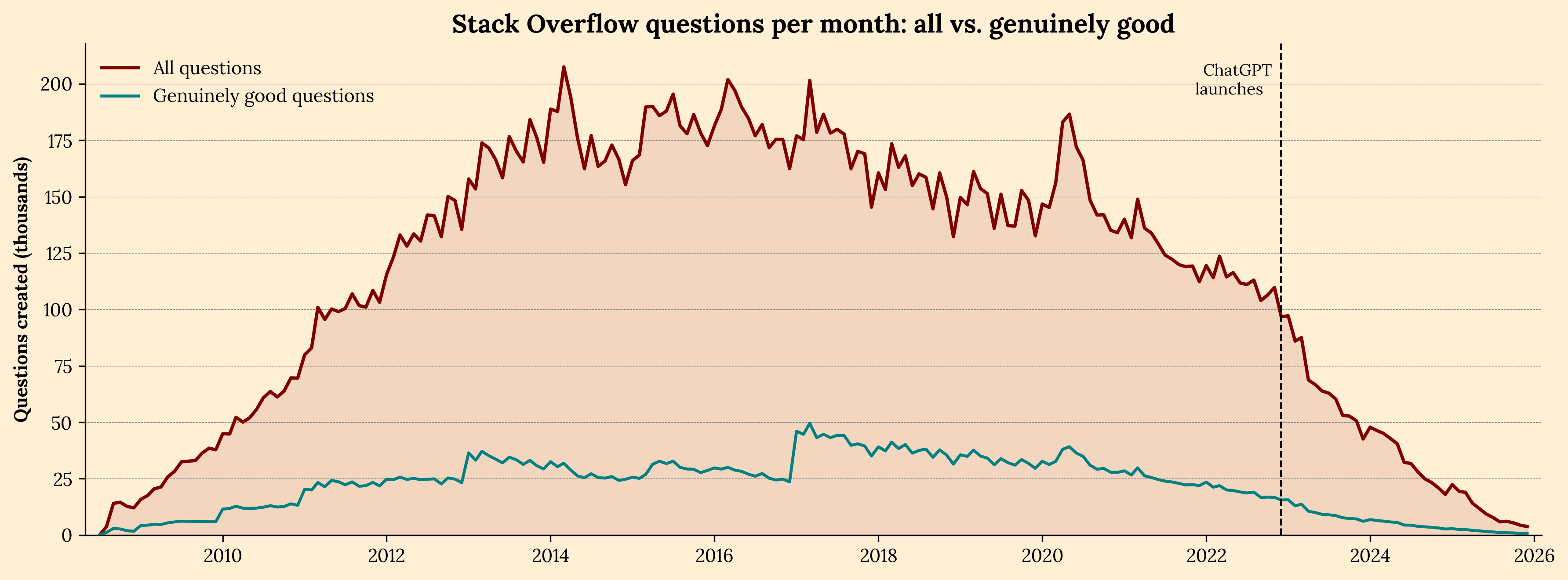
Through this lens, we see that even the good questions have been declining since 2017—but steadily, not drastically. There’s not a single steep drop anywhere. This, perhaps, indicates that while we may attribute declining volume to various events, the nucleus began eroding a long time ago. Have people been gradually running out of good questions to ask? That seems like a good explanation, but it does not stand up to scrutiny.
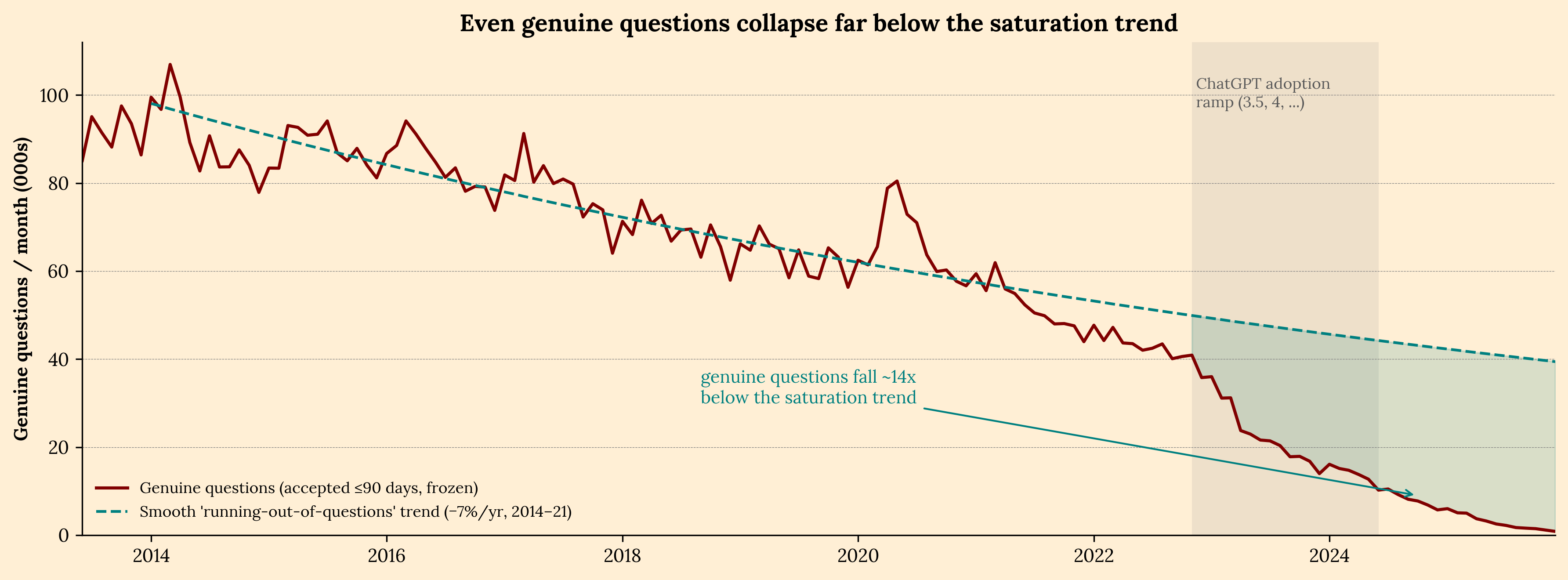
Extrapolating from pre-ChatGPT trends, we can see that only a year after the release of ChatGPT, good questions were at only half their expected volume. By 2025, they were at 7% of where they would have been. So even if users had fewer good questions, that cannot explain what happened next. Around the release of ChatGPT, the series breaks sharply from a trend that had held for years. This calls for further refinement: if asking good questions didn’t help the survival of activity, then perhaps we need to look at what these presumably good questions were about.
Short of analyzing the textual content of questions and answers (which would be exceptionally rewarding, but prohibitively expensive for me), the best place to look for the “about” is the tags which users and editors attach to questions. The researcher Nadia Eghbal mentions a classification of software tools into frameworks, languages, libraries and web and application servers. She used this taxonomy in the context of open source software projects on GitHub6, but the same can be extended to Stack Overflow tags. This helps us understand what was affected most.
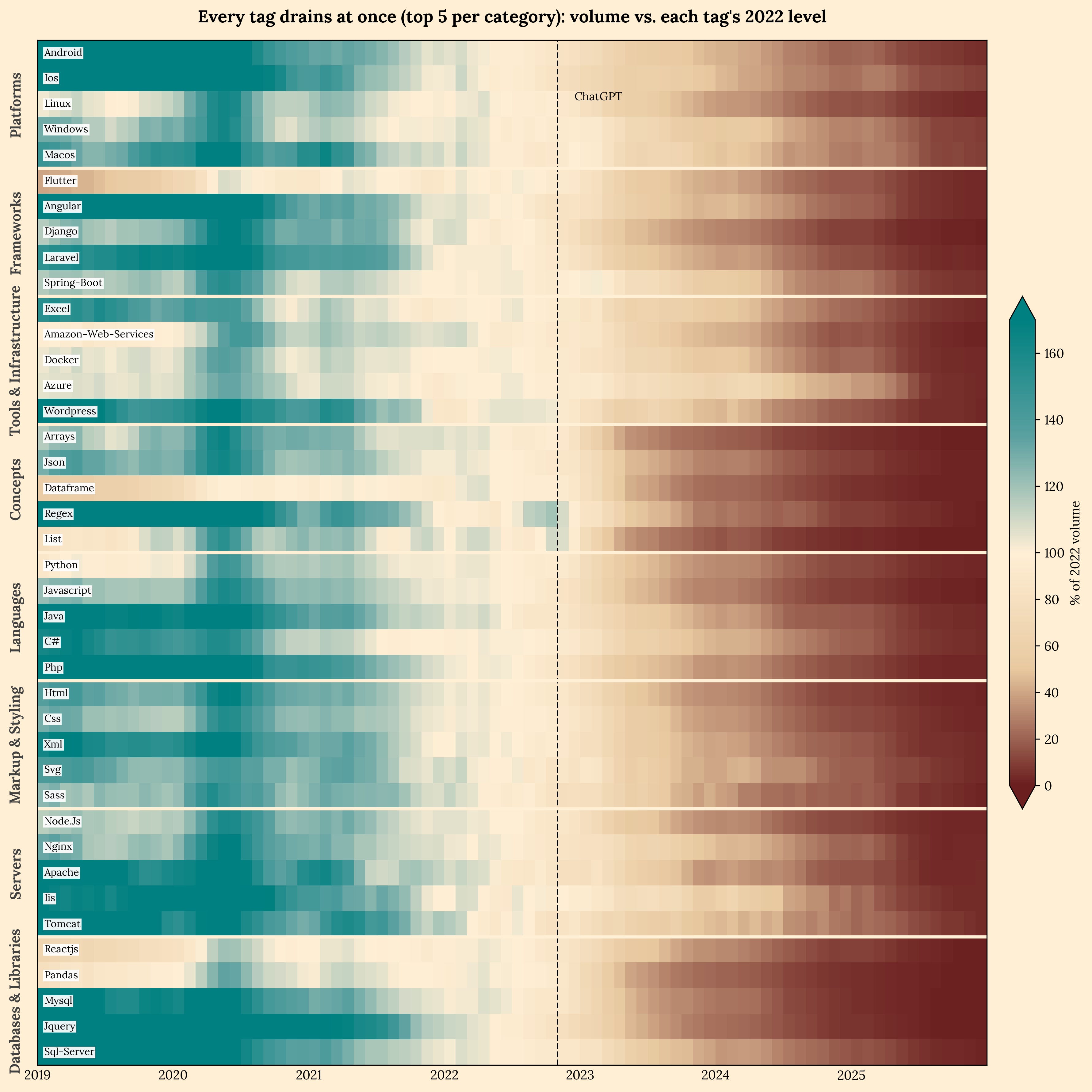
And the overwhelming answer is: everything. The technologies had very different histories before 2022, but by 2025 almost every part of the programming ecosystem represented on Stack Overflow had fallen to a small fraction of its 2022 volume. A minor nuance is that of all categories, libraries were hit the hardest, more than frameworks and languages. Some frameworks did gain traffic temporarily, but those were, unsurprisingly, LLM frameworks themselves.
An explanation for this near-universal collapse comes from a study by Robert DeLine7. He studied the kinds of questions programmers actually ask while working, some of which are general and portable: how to use an API, what a function does, how to express some operation in a language. Others are intensely contextual: why a particular piece of code exists, what state caused a failure, what the program is supposed to do, or why something was designed a certain way.
Stack Overflow is extraordinarily well suited to the first kind. Its great achievement was to take programming problems that arose in one person’s work and turn them into reusable public knowledge. Once phrased correctly, a question could be detached from the program that motivated it and answered for everyone. This also explains why the categories above matter less than one might expect. What languages, frameworks, libraries and servers have in common is not their subject matter, but that much of the general knowledge surrounding them can be made portable.
LLMs are unusually good substitutes for precisely this kind of knowledge. They do not need the programmer to locate the canonical question, discover the right vocabulary, or translate their problem into somebody else’s. The slightly larger collapse in libraries fits this interpretation: questions of the form “how do I use this API?” are among the easiest to detach from local context. But more crucially, the effect extends far beyond libraries. Mark Guzdial8 wrote about a study where the researchers found that people are surprisingly capable of describing programming procedures; the difficulty was not in the expression, but in navigating the abstractions imposed by programming languages. Coding agents are meant precisely to remove this hurdle.
However, that alone does not mean that LLMs have forever solved software engineering. Fred Brooks offers a useful way of seeing what this collapse of peer-to-peer discourse does not mean. He distinguished the accidental difficulties of programming—the machinery needed to express and manipulate software—from its essential difficulties: deciding what a system should do and managing the complexity inherent in it. Stack Overflow became a vast public repository for overcoming a great deal of the accidental difficulties. So even though traffic fell to a tenth of its previous volume, it doesn’t mean that software engineering is an order of magnitude easier than it was before ChatGPT. LLMs or coding agents do little to attack the essential difficulties of programming. Brooks writes,
The hard thing about building software is deciding what to say, not saying it. No facilitation of expression can give more than marginal gains.
Anyhow, as we return to our original question, we must admit (for my part, somewhat begrudgingly) that ChatGPT does appear to have killed Stack Overflow. But before we hang up our Bayesian hats9, there is a third aspect to consider. Stack Overflow isn’t just the questions and answers, it’s also a community. It’s not just a knowledge repository, it’s a social network. Just as we have seen what changed and when it changed, we must also ask who changed.
The Who By Numbers
It has been a mass exodus. Askers, answerers and editors10 all returned less and less often. After ChatGPT, they did not simply have lower individual activity—there was instead a very conspicuous absence. I would have thought that casual users would be the first to leave (which did happen), and then the tide would slow. But even the presence of the highly reputed elite core—who tried hard to not go gentle into that good night—halved. This is a sign of the decay making its way through the electron cloud and reaching the nucleus.
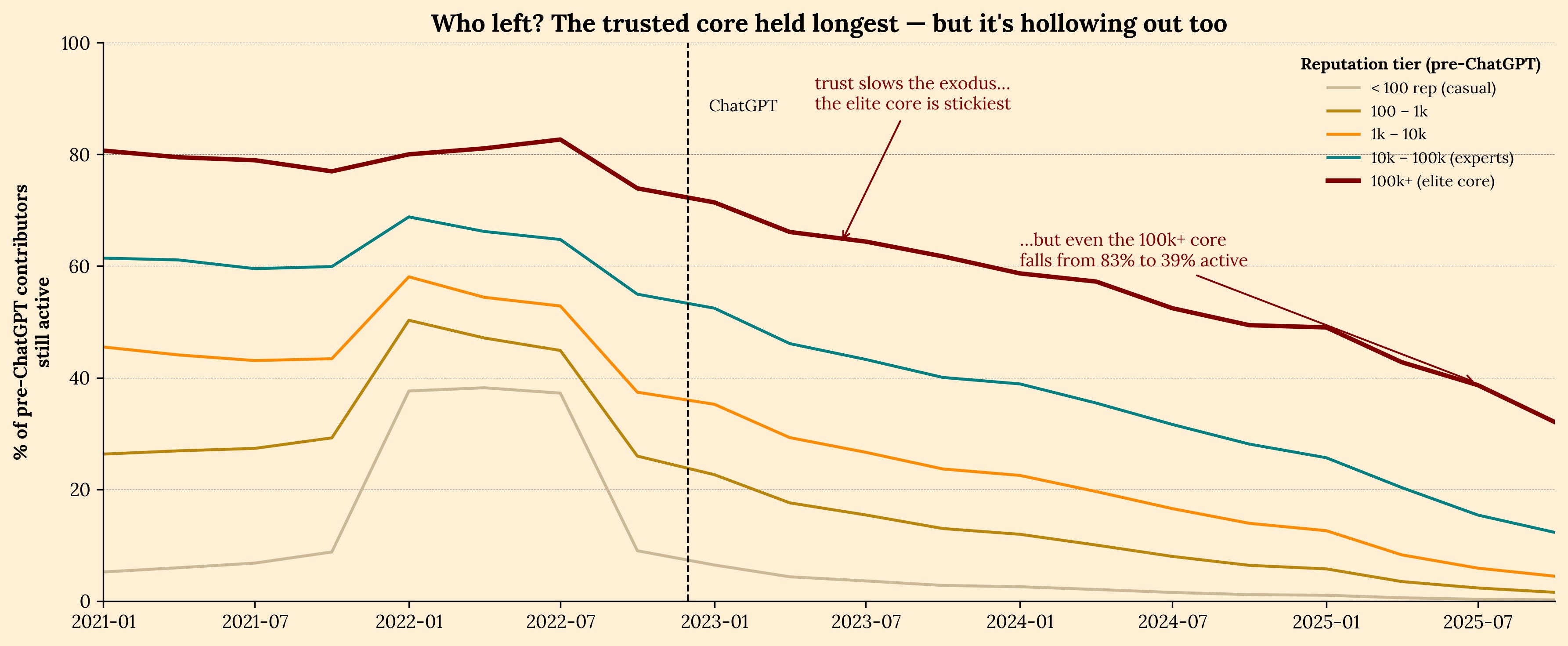
The community has always been extremely unequal (long-tailed Pareto distributions): a tiny elite atop a huge casual base. The top 1% often produced anywhere between one-third and two-thirds of all answers. But the exodus was across not just reputation, but also across experience. Everyone, from first-timers through the most seasoned veterans (100+ posts) fell by more than 90%. This alone invalidates the idea that ChatGPT removed only novices.
But alongside the concentrated core, there was another vulnerability that got exploited: Stack Overflow, by many accounts, made newcomers feel quite unwelcome.
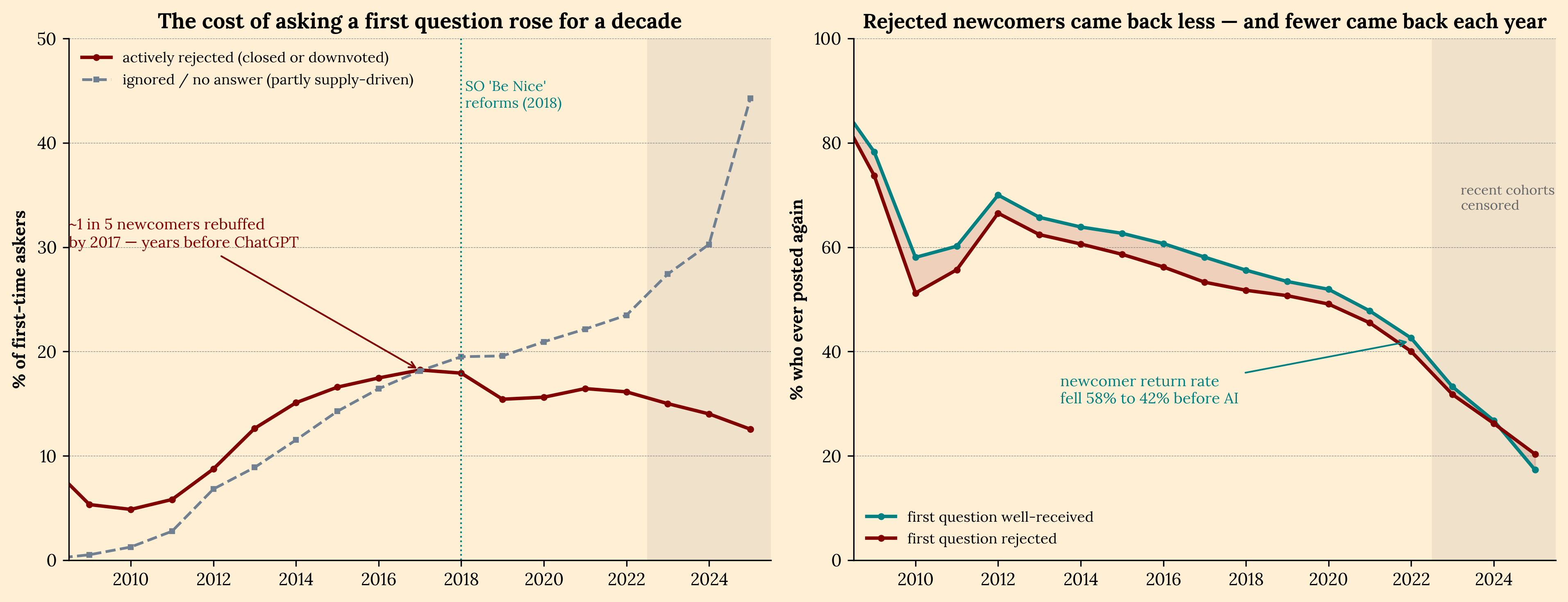
Long before ChatGPT, the driving away of newcomers rose from 5% to ~18% over a decade; while newcomers' return rates fell from ~58% to 42%. Unfortunately we cannot read more into the casual lurker cohort of users, since their footprint is hard to measure. But those would be exactly the kind of user who'd rather get a non-humiliating answer from a machine that could (pretend to) be both patient and quick.
Won’t Get Fooled Again
What do we learn from this? Why would something like Stack Overflow work in the first place? And why would it fall apart?
The first question is harder to answer. I think that people are often motivated by unreasonable things. There aren’t many ways of explaining why, for decades, millions of people shared knowledge for free. A lot of that content took hours to produce, not to mention all the effort involved in editing it and moderating the community. None of this is exactly rational behaviour.
But money wasn’t the only currency. Daniel Pink11 divides the motivations for doing difficult work for free into autonomy, mastery and purpose. The digital commons offered all three. You could choose where to participate, demonstrate your skill, acquire a reputation and most crucially, have a shared purpose. The digital knowledge commons turned individual autonomy, mastery and purpose into a public good12. And it did so at an unprecedented scale.
César Hidalgo13 offers many useful ways of thinking about why this matters. An individual cannot possess the knowledge and knowhow required to build a moderately complicated software system. Knowledge therefore has to be spread across people. What determines, more than anything else, how much knowledge a group can collectively possess is how easily they can form links with one another. Expensive links produce small, heavy and slow networks. Cheap links allow knowledge to be distributed faster among vastly more people. And trust makes those links cheaper still.
Stack Overflow was, among other things, an extraordinary machine for lowering the cost of such links. Voting, reputation and accepted answers supplied enough trust to make advice from an anonymous stranger useful—the toxicity notwithstanding. And Stack Overflow has forever had the best SEO. Google made that one interaction available to the next million programmers with the same problem.
All of this makes the role of AI generated answers rather paradoxical.
On the one hand we have low-cost peer-to-peer links, but on the other hand, LLMs have established even cheaper links between a programmer and the accumulated output of the network. And that, too, is a very awkward thought because ultimately, the accumulated knowledge of an LLM is not, after all, a network. So the question remains, what do we lose when we replace a network with a single, albeit much stronger, node? How long do links last when they’re not between two nodes of a large, distributed network?
Every private interaction with an LLM is one interaction that does not become a public question. And every question that is never asked is one fewer opportunity for someone else to answer it, earn reputation, practise their craft, help a stranger, or simply have a reason to return tomorrow. Our data suggests exactly this kind of unwinding. As question volume fell, answerers returned less often. The questions that remained received fewer answers and waited longer for them. A weaker service gives future askers still less reason to come back. What had been a virtuous cycle could run equally well in reverse.
Brooks’ distinction also resolves a puzzle about the long tail. AI is spectacularly good at dealing with long tails mechanically: it can ingest amounts of text that no person could hope to read and retrieve obscure fragments of it on demand. But there is another healthy sense in which a long tail exists. It is the consequence of millions of people each knowing, noticing and contributing tiny things that no central planner would ever have thought to collect.
Making the long tail easier to consume is clearly useful. Taken to its logical extreme, the best possible interface would make the long tail disappear altogether: no searching, no browsing, just the answer. And therein lies the trap. If making the tail invisible also removes the reasons people have to keep adding to it, we may eventually destroy the process that creates it in the first place. We don’t want to eat our own long tail, after all. The long tail is the necessary evil. The cost of searching for a needle in a haystack is also the cost of serendipity.
That doesn’t, of course, mean that Stack Overflow was the best possible place to create knowledge and knowhow. It already had trouble with that process. Long before ChatGPT, newcomers were increasingly likely to have their first questions rejected and increasingly unlikely to return. The mechanisms that kept the archive clean also made participation expensive. That did not cause the collapse after 2022, but it meant that when an extraordinarily attractive outside option arrived, the community was not particularly good at replenishing itself.
This is where my original suspicion was wrong. Stack Overflow was indeed in decline before ChatGPT. Good questions had been falling for years. Newcomer retention had deteriorated. The community was heavily dependent on a remarkably small core. All of that made the viral claim that ChatGPT had suddenly “destroyed” Stack Overflow seem much too convenient.
But the data is unequivocal. The decay has reached the nucleus.
That still does not mean that AI has solved programming. Fred Brooks’s 40-year-old distinction survives remarkably well. Tools can remove enormous amounts of the accidental difficulty of software—remembering syntax, finding an API, translating an intention into code—without eliminating its essential difficulty: deciding what the software ought to do, understanding the world it inhabits, and managing the complexity of the thing itself. In other words, the disappearance of 90% of Stack Overflow’s traffic isn’t equivalent to, or even correlated with, software engineering becoming 90% easier.
It means something more specific, and perhaps more consequential. Stack Overflow built a commons in which the act of solving one person’s problem also produced knowledge for everybody else. ChatGPT made it possible to consume the fruits of that commons without participating in it.
So, did ChatGPT kill Stack Overflow? It would seem so.
The harder question is who will bother to write the next answer down.
We're being told that that's about to change: AI can write all the code you want, and programming is a job ripe for automation. We'll see about that.
Having someone looking over your shoulder as you write code is extremely unnerving even to the most seasoned programmer.
There's also a website, Let Me Google That, which gently mocks users who "don't show their work".
There are many not-so-modest views of how transformative genAI is—from simply making everything we know obsolete to curing cancer, solving climate change and ushering in an era of abundance.
Specifically, questions here are scored by their net upvote tally (upvotes minus downvotes) and then filtered by whether they remained in the top quartile of all questions asked in the same year.
Robert DeLine, "Code Talkers," in Making Software, ed. Andy Oram and Greg Wilson (O'Reilly, 2010).
Mark Guzdial, "Why Is It So Hard to Learn to Program?" in Making Software, ed. Andy Oram and Greg Wilson (O'Reilly, 2010).
In the short history of Being Bayesian, this is the first time my prior assumptions have been properly falsified.
defined by the predominant activity over a user's lifetime on the platform.
Daniel H. Pink, Drive: The Surprising Truth About What Motivates Us (Riverhead Books, 2009).
Yochai Benkler, Coase's Penguin, or, Linux and The Nature of the Firm, Yale Law Journal, 2002.
César Hidalgo, Why Information Grows: The Origin of Order, from Atoms to Economies (Penguin, 2015).
Always learning something new with each of your posts, Jaidev! This was a bit easier for me to get into and I really enjoy how the piece got me asking more questions! Chief being: What's going to be after StackOverflow. As you pointed out: while LLMs make information sharing easier, what is lost in the process is a massive (albeit increasingly toxic) community. And I think the emergence of smaller communities across people's geographic and cultural contexts would be really cool.
BTW: A big "The Who" fan myself! In my college days, I had trouble waking up in the morning (Staying up all night chasing rabbit holes the night before) and in my final year, I downloaded an alarm app that forces you to solve a puzzle before you can switch it off. I set up "Teenage Wasteland" as my alarm. Turns out the app wouldn't work because my friends would tell me I would solve the puzzle and go back to sleep. I have no recollection of doing so :D
This is such a good piece Jaidev. I am not a programmer but I learnt so much about the community / participation through it. Thank you for writing it and being a shining example of our program (er... not a computer one).
Also - yes found the Easter eggs, Baba. Oh, really! :)