

The moments that make up a dull day
Two years ago, I went on a boat ride on the Mekong river in Luang Prabang. There was something ineffable about those two hours. The gorge was beautiful, wide and flanked by sheer cliffs — some of which had caves in them. And since the gorge was broad, the water was unnaturally still. My tour guide was skilled and therefore, quiet. Even the boatman was skilled — he knew precisely when to shut off the motor and let the boat be. My wife, I and the tour guide would occasionally pass each other a banana or a beer can. But for the better part of two hours, nobody spoke. The cliffs had an elemental effect — as if one should fall silent in their presence. Even whipping out your phone to take a picture is an affront to the deep, still river. It demands and obtains the toll of singular, unflinching attention.
Sadly, since that trip to Laos, I have failed to curate for myself more such experiences. It hasn’t been for the lack of trying. My wife and I promised ourselves that we would travel more, and we went to jungles, beaches, mountains — many of them arguably more serene (if you believe travel bloggers and online reviews — which you shouldn’t) — than Luang Prabang. It is only now that I’ve started developing an inkling of what the missing ingredient might be: it was, quite simply, being present.
That trip to Laos had coincided with a major professional milestone. The hard work of a decade had paid off handsomely. The skills acquired over fourteen years had finally amounted to something very tangible. I decided to take a sabbatical, and so there I was, floating on the Mekong with not a care in the world.
The sabbatical brought with it a great many things — including the inception of this very publication. But more than anything else it brought me unprecedented clarity of thought and peace of mind. And here, I suspect, I fell prey to the fallacy of the single cause. The sabbatical brought me immersion, and I thought only something like it could bring me immersion. Eventually, the sabbatical ended and I went back to work. And with work returned the questionable distinction of being a workaholic. It had served me well in the past, and it would serve me well now. But being a workaholic also means losing the ability to switch off.
Back in the day my dog had learned to recognize the sound of the keyboard falling silent. It meant that it was perhaps time for her walk. Today, that familiar clacking is far less prominent in her life — not least because LLMs are doing most of my typing for me; her workaholic human is now rarely available in the evenings. She still walks him at night, but that’s only because he doesn’t walk her anymore. Even late at night when they’re both sitting on a park bench, he cannot resist pulling out his phone to check the progress his coding agents have made; but she’s happy touching grass — greedily sniffing every inch of it and rolling around trying to get the scent in her fur — she doesn’t know if she can bring him to the park tomorrow. She knows that his attention is expensive. And if she had the slightest interest in anything except sniffing grass, she’d realize that lovely as she is, she’s not the Mekong.
And despite all of this evidence to the contrary, I am somehow immensely confident in my ability to switch off. Every Friday evening I turn off notifications from work until Monday morning. Every time I take a vacation I uninstall Slack. And every time I fail to stay away. Most recently, on a week-long trip to the Andaman Islands I uninstalled and reinstalled Slack twice, and I must have checked my email at least 20 times. Thank heavens my colleagues and I don’t speak to each other on WhatsApp. That would be a nightmare. But a part of me also knows that I’d perhaps happily live through it, too, if it really came to that.
In short, I am Piyush Goyal’s poster boy: that tireless and constantly available Indian worker who’s completely unaware of foreign ideas like the weekend or 5 o’clock — or even the sunset.
The starting gun
Last month, speaking to an audience of Dutch businessmen, Piyush Goyal said,
We are a large country ... young, talented, skilled, aspirational, looking for a better quality of life for themselves, for their children, for their families; ... willing to work hard. Nobody in India will tell you it’s 5 o’clock, and certainly, no Indian will remind you it’s the weekend.
At “5 o’clock”, he takes a well-rehearsed look at his wristwatch. And at the end, he duly pauses for laughter.
To be fair, it is funny in a certain sense. The hardworking, underpaid, overworked, forever eager-to-please Indian is far from the most offensive stereotype. But it’s also funny because the minister seems to be oblivious to the contradiction between “looking for a better quality of life” and cheap labour. His colleagues in Indian politics never tire of accusing each other of having a colonial hangover, while at the same time he has no qualms advertising the stereotype in a European country, of all places.
Not long ago he scolded Indian startups for “turning unemployed youth into cheap labour”. It’s a delicious irony that the Union Minister of Commerce & Industry has drawn up his full height to celebrate on European soil what he once criticized in India.
You could argue that the speech, as a whole, was a good one. And you would be right. Why, then, take these few sentences out of context? In a country where even the PM can barely speak without a teleprompter, why make a big deal out of an elected official not choosing their words more carefully?
I can think of at least three reasons. First, I may be a workaholic, but I’m still jobless enough to want to die on obscure hills. Second, it is precisely the gaffes of public figures that pave the way to illuminating reality. Third, Piyush Goyal dislikes people getting into the math of what he’s said (since it did not help Einstein discover gravity).
So that’s exactly what we shall do.
And you run, and you run to catch up with the sun
Prima facie, there’s nothing wrong with the minister’s claim. It’s reasonable to believe that most salaried Indians are still at their desk at 5 pm, and that most work on weekends: 91% do some paid work on a Saturday and 57% on a Sunday. In fact, we could simply replace the generalizing phrases like “nobody in India” with “few salaried Indians”, and the statement would come closer to the truth. After all, even in the most emancipated work cultures, you can barely expect people to follow the strict 9-to-5 schedule.
However, it is the spirit of the statement that is under scrutiny here. What does the working class in India do in the evenings and on weekends? Who, precisely, are the people who work late evenings, and how do they differ from people who don’t? To answer these questions, we return to NSO’s Time Use Survey of 2024. Now, the minister’s claim is about willingness and disposition towards work. The survey doesn’t measure that, but it does tell us how Indians spend their time. The survey itself is comprehensive, and paints a detailed picture of an average day in the life of practically every Indian. But we limit ourselves only to salaried respondents—mostly to keep things as relatable as possible—I’m salaried1, and you are most likely salaried, too. As expected, about 70% of this cohort are still working at 5 pm.2
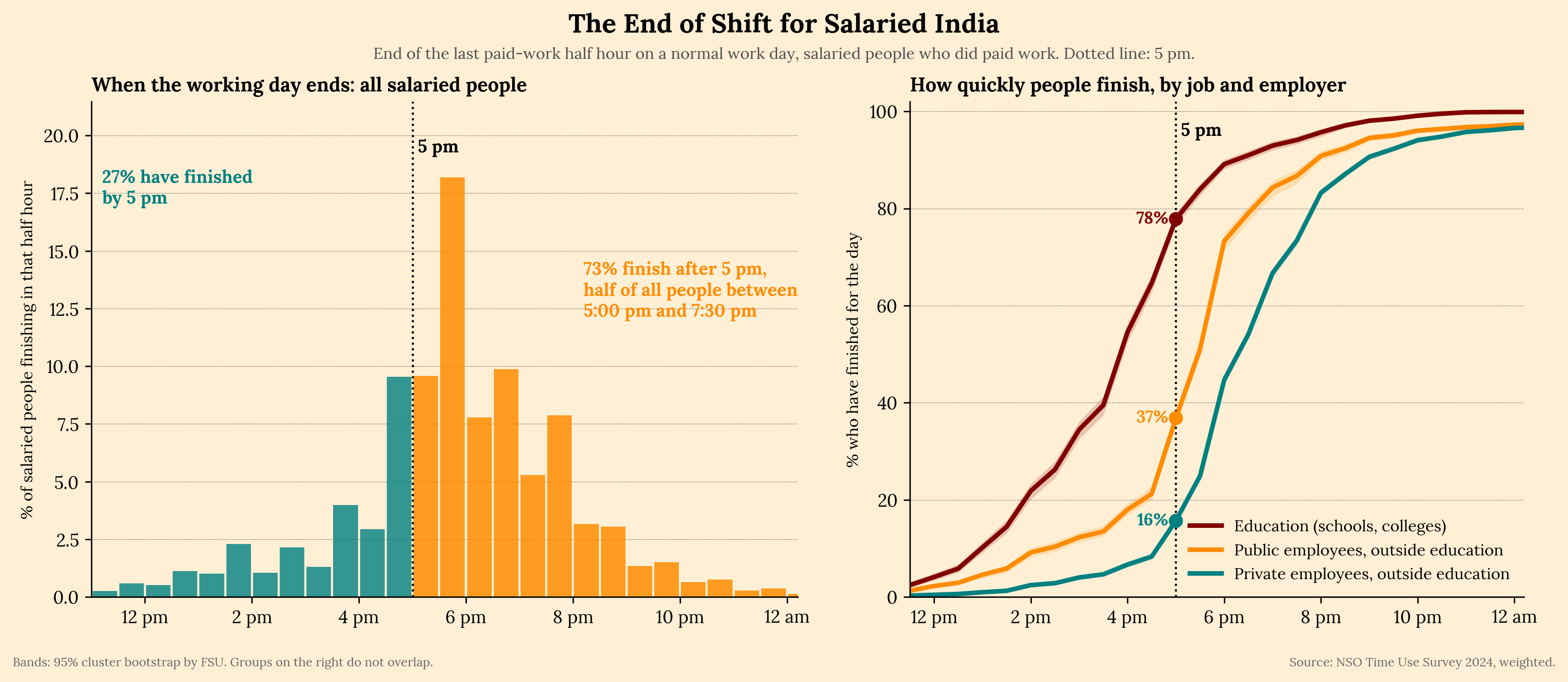
People working in education are more likely to have finished earlier, presumably because schools and colleges have fixed schedules. Outside of education, 63% of public sector workers and 84% of private sector workers have not finished working by 5 pm. So the initial claim is about half-right. By 7 pm, a quarter of all salaried employees (education included) are still working, and within two hours, only 7% are still at their desk. Since we’re interested primarily in the part of the workforce that was being advertised, we set education aside for the remainder of the analysis.
The next step is to ask what seems3 to govern people’s evenings—not just the end of the day’s work, but also what follows. To answer this, we take three large industry groups, together about half of the non-education salaried workforce, and split each by gender into six mutually exclusive groups. The industries are i) health and public administration, ii) knowledge services and iii) trade, transport and hospitality. For both men and women, work finishes earliest in the health and public administration sector, and last in trade / transport and hospitality.
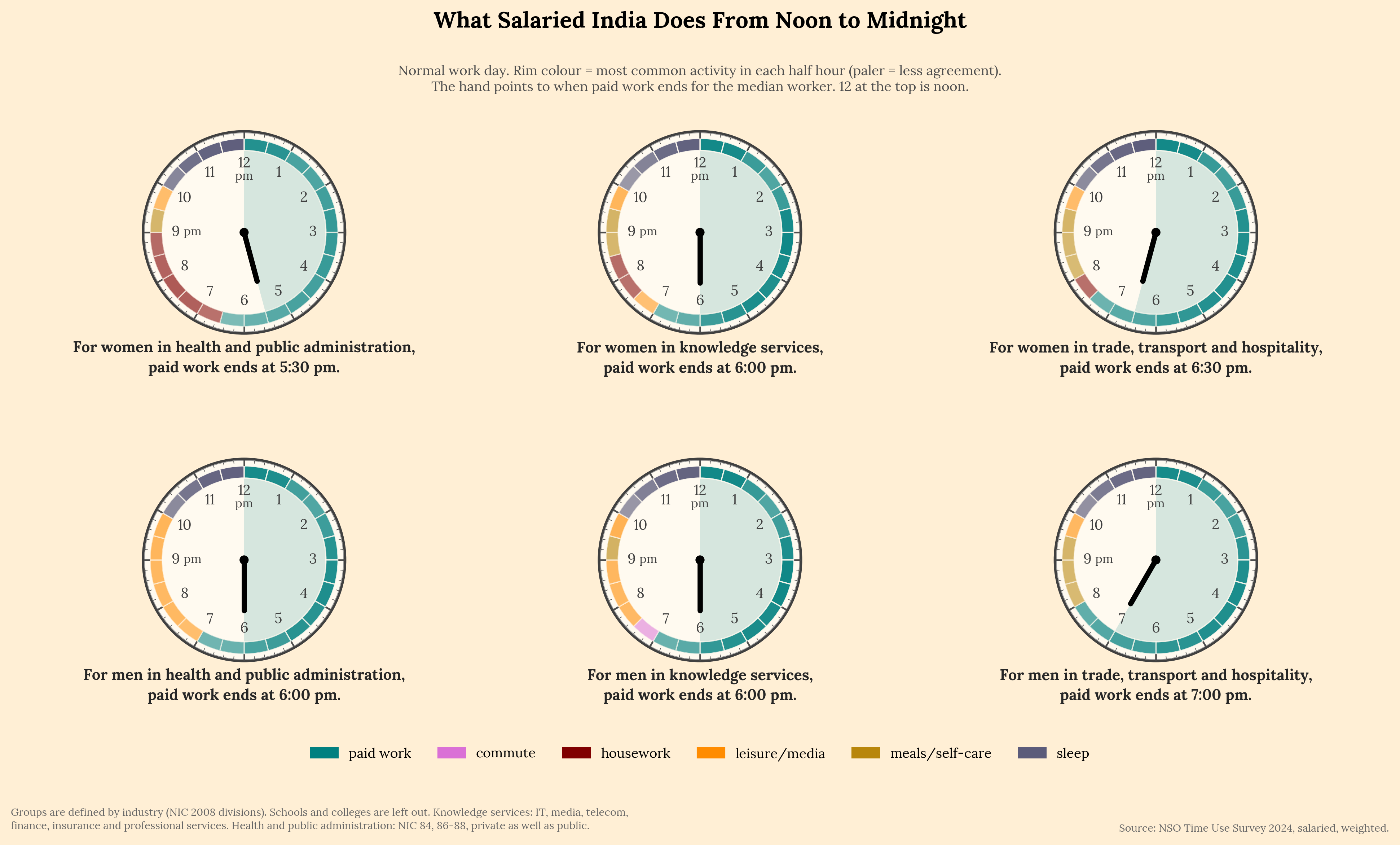
Note, however, that women spend far more of their evenings on housework than men do: about an hour between 5 pm and midnight, against eight minutes. It’s a bit like a gendered twist on Parkinson’s law: the earlier women finish work, the more time they spend on housework, whereas for men, the evenings fill up with leisure.
This gender imbalance is, unfortunately, the fulcrum on which this entire piece rests. Every story about time use, and indeed, about productivity in the labour economy inevitably turns into a gendered problem. In the same speech, Goyal said, “... more and more of our women are coming into the workforce; they don’t want to be washing clothes at home.” He also said something about more washing machines being sold in India than in the rest of the world put together. But sales may have little to do with penetration. According to the HCES, only about a third of households that live mainly on a wage or salary have one (46% in cities, 21% in villages), and 21% of households overall. Nor is having one associated with substantially less time spent on laundry. In the TUS, women in households that wash clothes by machine spend only about four minutes a day less on laundry than comparable women in households that wash by hand, and men spend under two minutes either way4. Households that outsource it are the exception, at about 26 minutes less, but only about 3% of salaried households do. The larger point is that if more women come into the workforce, someone still has to do the housework.
As more women enter the workforce, the housework must either be shared, outsourced, automated or left undone. The two visions of the future—one where hustle continues to be a flex and the other where there are more women in the workforce—don’t necessarily contradict each other, but they raise an uncomfortable question: whose sunsets and weekends will pay for them both?
In fact, the tradeoff becomes even more precarious when we consider the second aspect of the Indian hustle flex: the weekend5. Here, too, the minister is somewhat right about the facts, while being spectacularly wrong about what they mean. He’s right in that many people (almost a fifth of our cohort, for about six hours on average) work on their days off. But the burden of housework is overwhelmingly borne by women.
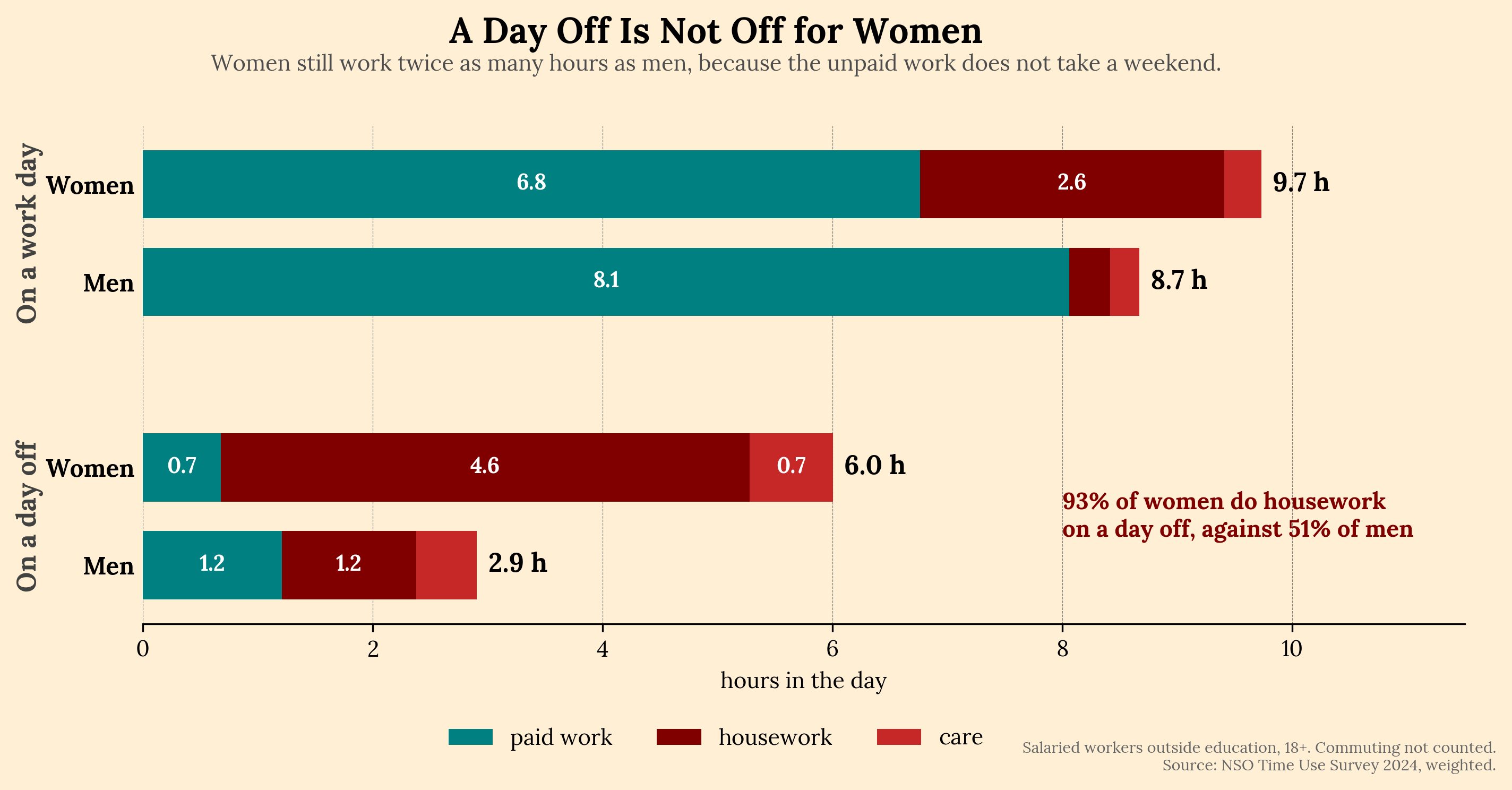
These are the same women who “don’t want to be washing clothes at home.” It may be they don’t want to, and would much rather be doing paid work. I won’t presume to speak on behalf of women, but something tells me that the hustle flex won’t survive no matter how many dishwashers and washing machines are sold in India.
The sun is the same... but you’re older
After having spent some time away from it, looking back at the previous section, even I admit that a lot of it seems like attacking a strawman. I even admitted earlier that it was a good speech, and that I was deliberately taking a couple of sentences out of context. But it’s precisely this investigation that has revealed what needs to happen for our vision of the modern, industrious workforce to be true: both in the letter and the spirit.
In Jewish folklore, a Golem is an anthropomorphic creature made of clay. It is brought to life by writing the word “Emes” (truth) on its forehead, whereupon the Golem would turn into a perfectly obedient automaton with limitless stamina and strength.
Who wouldn’t want a workforce of Golems? In Indian folklore, people have something far more influential than the simple truth inscribed on their foreheads: their fates, determined in no small part by the accident of birth. That inscription cannot be altered by speeches alone. On the other hand, there’s the risk of the description of how Indians work, when advertised to prospective employers, becoming a prescription for how they ought to work. And unlike Golems, humans have obligations, ambitions and limitations that cannot simply be erased. Those with the power to shape these expectations must exercise great care. Otherwise, as one version of the legend goes, the Golem could collapse under its own weight and crush its maker beneath it.
The very first chapter of Caroline Criado Perez’s book, Invisible Women, is titled “Can Snow-Clearing be Sexist?” She starts with the story of how the public officials in the town of Karlskoga, Sweden were addressing gender-equality initiatives: re-evaluating policies through a gendered lens. An official joked that at least “snow-clearing was something that the ‘gender people’ could keep their noses out of.” And as it turns out, even in Sweden, something as seemingly gender-neutral as snow clearing has disproportionate consequences for men and women — primarily because while snow is unisex, driving, public transport, sidewalks and pushing a stroller is not. We should perhaps ask if the hustle and the grind are sexist too—both on the demand and the supply sides.
None of this is to say that hustling is bad. I myself on occasion have taken some pride in spending long hours at work. But times change. A decade ago my friends and I would share productivity tips. Today we share physiotherapy recommendations. Workaholism has, like everything else, costs and benefits. For those of us privileged enough to choose workaholism, it is a bargain we can afford to make. Not everyone has that luxury. Only yesterday, a colleague—the person who manages our office—asked me to subscribe to his YouTube channel. I did, only to discover that we, the office staff, were his content. His latest vlog was about being late for work. He’d left home almost at sunrise (it’s already winter in Delhi), and returned home after dark. I’d like to believe he enjoys the routine, and that he’d choose it even if he had alternatives. But I don’t know. Until he made that video, it hadn’t even occurred to me to wonder. Speaking for myself, the cost only seemed low: I’m still not good at switching off.
And now my dog is nudging my elbow. She’s sensed the keyboard going silent.
When we say "salaried" we also include people who receive regular wages.
"Still working" means 5 pm falls between a respondent's first and last half hour of paid work that day, so it includes people who are on a break at that moment: lunch, tea or a midday gap of up to four hours. If we count only those whose diary shows paid work in the 5 pm half hour itself, the figure is 61% instead of 69%, so about 8% of salaried people are between stretches of paid work at 5 pm. The estimate barely moves if the break limit is anywhere from one to six hours (67% to 69%). Another 27% have finished for the day and 1% did no paid work that day. The remaining 3% are mostly people whose gap in paid work at 5 pm is longer than four hours. Of those who did any paid work that day, about 73% have not yet finished
Yes, yes, I know, correlation is not causation. But throwing correlation away just because it is not causation is like throwing the baby out with the bathwater.
Women in salaried households, TUS 2024. The difference is 4 minutes a day (95% interval about 3 to 5) after accounting for rural or urban, age, household size, per-capita spending and the woman's own work status. It is a comparison across households, not a measured effect of buying a machine. Richer households both own machines and may have more laundry. Washing itself is 4 minutes shorter; drying and ironing barely differ. Moreover, a washing machine may save effort, not necessarily time.
Not literally a weekend, but any day off from work.
Good read Jaidev. Its interesting how you connect everyday experiences to culture to government data and public affairs. Keep writing 👍